
By Ulrich Philipp
Baden-Baden. Margret Mergen’s term of office as Mayor of Baden-Baden included 2015, the year in which the great movement of refugees to Europe began. In the years that followed, more and more people from the world’s crisis regions arrived in Baden-Baden too.
Mergen was convinced that the city should do something for the countries the refugees come from. She set out to find projects or organisations that effectively tackle the causes of flight. Eventually she found Michaela and Thomas Bleile from Munich.
The couple were planning to found a school in the Mityana region of Uganda, almost 6,000 kilometres away. The school opened in 2022, and today around 170 children and young people are taught here every day.
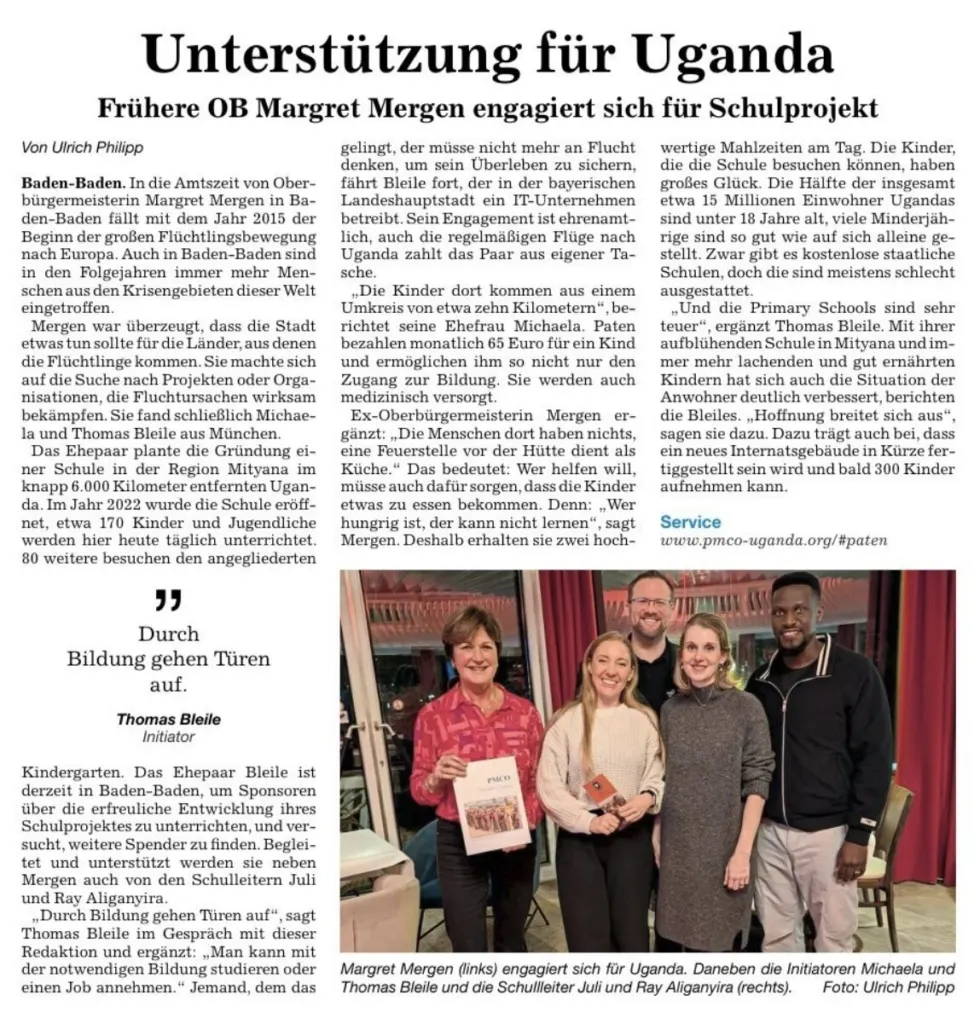
A further 80 attend the attached nursery school. The Bleiles are currently in Baden-Baden to inform sponsors about the encouraging development of their school project, and are trying to find further donors. They are accompanied and supported not only by
Mergen but also by the head teachers Juli and Ray Aliganyira.
“Education opens doors,” says Thomas Bleile in conversation with this newspaper, adding: “With the necessary education you can go to university or take a job.” Someone who manages that no longer has to think about fleeing in order to survive, continues Bleile, who runs an IT company in the Bavarian capital. His commitment is voluntary, and the couple also pay for the regular flights to Uganda out of their own pocket.
“The children there come from within a radius of about ten kilometres,” reports his wife Michaela. Sponsors pay €65 a month for a child, giving them not only access to education. The children also receive medical care.
Former Mayor Mergen adds: “The people there have nothing; a fireplace in front of the hut serves as the kitchen.” That means anyone who wants to help must also make sure the children get something to eat. Because, as Mergen says, “those who are hungry cannot learn”. That is why they receive two high-quality meals a day. The children who are able to attend the school are very fortunate. Half of Uganda’s total population of around 15 million are under 18, and many minors are left more or less to fend for themselves. There are free state schools, but most of them are poorly equipped.
“And the primary schools are very expensive,” adds Thomas Bleile. With their flourishing school in Mityana and more and more laughing, well-nourished children, the situation of local residents has also improved markedly, the Bleiles report. “Hope is spreading,” they say. Another contributing factor is that a new boarding house will be completed shortly and will soon be able to take in 300 children.